
STORE INFO
Location & Store Hoursmy cart
Secure checkout
Sometimes one CBD product feels completely different from another, even when the dose is identical. An oil might work quickly, while a gummy with the same amount barely registers.
That difference has to do with how your body absorbs CBD.
It’s all tied to CBD bioavailability, which plays a big role in the entire CBD experience.
CBD bioavailability refers to the amount of CBD your body can actually use. A dropperful of a CBD tincture or a gummy you eat has a clear milligram amount, but only a fraction reaches your bloodstream.
Along the way, enzymes break some of it down, the liver filters a portion out, and a bit can get lost before it ever has a chance to circulate. Because of that, the difference between what you take and what your body absorbs can be quite big.
Actually, oral CBD bioavailability is 13-19%, which means that at least 81% of the CBD you take is not absorbed.
Also, CBD doesn’t dissolve in water, and that alone plays a big role in CBD bioavailability. When something is fat-soluble, your body absorbs it more easily when it has a source of dietary fat to go with it. Without it, the CBD absorption rate drops because your body has a harder time breaking it down and moving it through the system.
Because of all of this, some people think CBD doesn’t work for them. In reality, the problem is low CBD absorption.
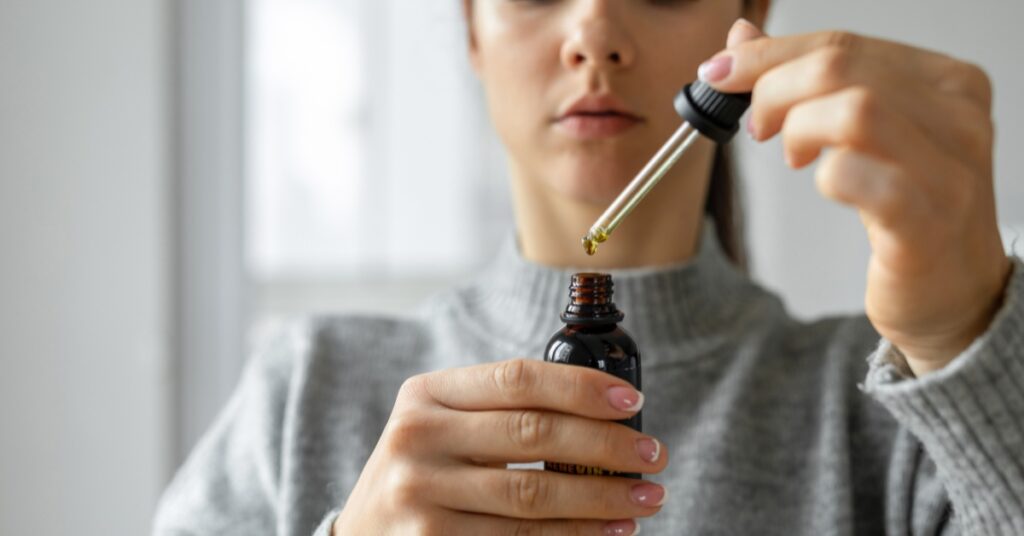
With each delivery method, CBD moves through your body in a different way. This can create big differences in CBD bioavailability, CBD absorption, and your overall experience.
Tinctures offer the most direct route. When you hold the oil under your tongue, the CBD can pass through tiny blood vessels you have there and directly into the bloodstream. This usually leads to a higher CBD absorption rate.
How long you hold it under your tongue matters, too. Longer contact times give CBD more time to reach your bloodstream.
Capsules are simple and precise, but they rely on digestion. Your body has to break down the capsule, process the oil, and then absorb the CBD. The CBD absorption tends to be lower because a lot of CBD gets lost before it reaches the bloodstream. They work well for steady, longer-lasting effects, but not fast absorption.
Edibles go through the same digestive pathway as capsules, and the liver processes a large share of the CBD. This lowers bioavailable CBD. The taste and convenience are still there, but the CBD absorption rate is on the lower side.
Inhalation can offer the highest CBD bioavailability. CBD enters through the lungs and reaches the bloodstream very fast. You feel the effects sooner and lose less CBD along the way. Smokables are not right for everyone, but they deliver strong CBD absorption with little delay.
The skin is built to keep most things out. Only a small amount of CBD can get past, so almost none of it becomes bioavailable CBD in the bloodstream. CBD topicals are meant to work on local receptors, which is why they’re used for targeted areas instead of full-body effects.
After hearing how much CBD gets lost along the way, it’s easy to assume the whole thing is a losing effort. It isn’t. Your body can absorb CBD effectively; it just needs a little support. A few small things can make a big difference:
Because CBD is fat-soluble, eating something with healthy fats can help raise the amount of bioavailable CBD. A small snack like nuts, yogurt, avocado, or a spoonful of peanut butter can improve how CBD dissolves, resulting in a stronger CBD absorption rate.
MCT oil is one of the most effective carrier oils for CBD. It digests quickly, and your body can use it right away. This helps increase CBD absorption and gives you more predictable results. If you’re comparing tinctures, the carrier oil is one of the most important details to look at.
Quality has a big impact on CBD bioavailability. A clean formula absorbs more reliably because the CBD stays stable and evenly mixed with the carrier oil. Look for products that use tested ingredients, clear extraction methods, and third-party lab reports. Well-made tinctures and gummies deliver CBD evenly and without unnecessary additives, which supports a steadier CBD absorption rate.
Sublingual use allows CBD to enter the bloodstream almost immediately. For a better CBD absorption rate, let the oil spread under your tongue and warm up. That way, it covers more surface area. Also, try not to eat or drink right before taking it, because extra saliva can water it down and lower CBD bioavailability.
Your body responds better when CBD is taken at regular times. Consistency doesn’t change the chemistry of CBD absorption, but it does help maintain more stable levels of bioavailable CBD. This makes the overall effects easier to notice and track.
There are a lot of new products on the CBD market that all have the same aim. Make CBD easier to absorb by breaking it into smaller particles or surrounding it with compounds that help it mix with water.
Nano CBD uses high-pressure equipment and emulsifiers to break oil into tiny droplets, water-soluble CBD coats the oil with surfactants so it disperses in liquids, and liposomal CBD surrounds it with small fat-based bubbles meant to protect it through digestion. In theory, all of this should work to raise CBD bioavailability, but tiny droplets of CBD are still oil, even when dispersed in water.
It's very impressive, but the science behind many of these claims is still thin. Most studies are small, brand-funded, or focused on the theoretical. So, until more independent studies confirm how these formats perform in real conditions, traditional oils remain the most consistent way to support bioavailable CBD.
A well-made tincture with a good carrier oil, paired with a few good habits that help CBD bioavailability, is still the way to go.
Understanding CBD bioavailability gives you a clearer picture of why products feel different, even at the same dose.
Most of the factors that change CBD absorption are simple: The format you choose, the carrier oil, how you take it, and the overall quality of the formula.
Newer technologies like nano, water-soluble, or liposomal CBD are interesting, but they still need solid independent research before they can be considered better than well-made traditional oils. If you stick with quality products and a routine that supports a steady CBD absorption rate, you’ll get far more out of your CBD than what is expected.
